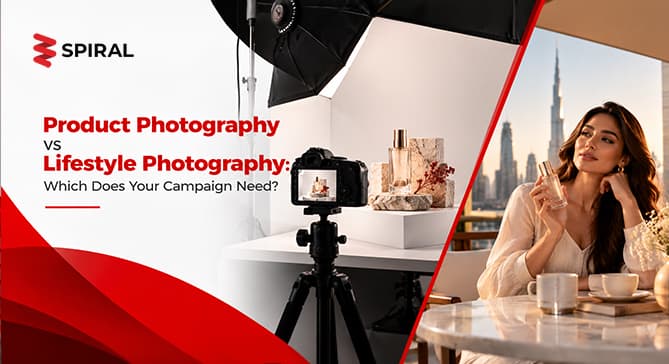
Product Photography vs Lifestyle Photography: Which Does Your Campaign Need?
Product photography is best for clarity and ecommerce, while lifestyle photography adds context, emotion, and brand storytelling. Learn when to use each and how to combine them effectively.
Introduction
When a company is organizing a new campaign, photography goes beyond just taking good photos. The type of images selected can affect the consumers' perception of the product, their feelings towards the brand, and usage of the content. Because of this, it is important to understand the differences between product and lifestyle photography before planning the commercial shoot. Product photography and lifestyle photography have different objectives. The first type aims to show the product clearly, while the second one tries to place it in a real or attractive setting.
For a number of companies, the best way is not to identify one category but to use the other one instead. The right choice depends on the goals of the campaign, product, target audience, and channels of publication of the pictures.
What Is Product Photography?
Product photography is usually focused on the product itself. The product is photographed in front of a plain background with strategic lighting. The aim is to present the product to the viewers in a way that they do not lose focus on it.
The appropriate e-commerce photography might include:
- Photos from the front
- Photos from behind
- Photos with different angles
- Close-up shots
- Pictures of the boxes
- Photos with the product in groups
- Pictures showing different options of one product
For a person who is shopping online, these images provide information such as the way the product looks and the color Shopify.
The primary goal is clarity.
What Is Lifestyle Photography?
Lifestyle photography refers to the manner in which a product is captured in combination with various elements of context instead of being shown alone in isolation from its surroundings. This context could be created through photographs showing a person using the product or showing it in a specific setting and outdoors. It could be photos capturing the experience of using the product or the idea of its relationship to various surroundings.
Lifestyle photography is unique in its ability to communicate experiences that cannot be shown in traditional product photography, including:
- How the product works or how it is used
- Its dimensions or scale
- Where it belongs and what the name of that place or setting is
- What is the overall vibe of the image
- What is the experience of using or possessing the product
- Being part of everyday life
Shopify defines lifestyle photography as the technique of showing products in the field, which allows customers to have an idea of what the product is like before purchasing it.
Product vs Lifestyle Photography: The Main Difference
To be able to differentiate between these two concepts, we need to figure out what each type of image depicts.
The aim of product photography can be summarized as: What is the product worth?
In contrast, lifestyle photography represents the answer to: How will I use this product?
A product photo can show a handbag from multiple angles, along with its shape, color, and different aspects of the object. Meanwhile, lifestyle photography can show a person using this handbag for shopping or partying.
Both types of photography serve different purposes and transmit different meanings. The former gives some information about the product, while the latter explains it all in a contextual way. Clear distinction is observed in commercial photography advice, which states that product photos are basically meant for depicting the product clearly, while lifestyle photos serve the purpose of showing how this product is used in daily life.
When Should You Choose Product Photography?
Product photography must be prioritized, particularly in cases where precision and product visibility are essential factors. For instance, e-commerce companies must often utilize high-quality images for product pages or online catalogs. Since a client cannot observe an item in person through a screen, detailed photography is necessary.
Product photography can be particularly useful for:
Ecommerce Product Pages It is important for customers to see the particular item they wish to purchase. Product photos taken from various angles will make it easier for customers to judge a product.
Online Marketplaces It is common practice to keep the same product presentation in marketplace listings, and clean imagery facilitates product comparison.
Product Catalogues When a catalogue features lots of products and/or their variations, cohesion in photography helps in terms of visual clarity.
Product Launches A product can need multiple photos showing it, its packaging, features, and variations.
Paid Product Advertising An ad call to action to buy a particular item should also make it clear what that item looks like.
The important principle is simple: if the customer needs to inspect the product, product photography should be part of the campaign.
When Is Lifestyle Photography More Useful?
Lifestyle photography becomes more valuable when the campaign needs to communicate an experience rather than simply display an item.
Imagine a furniture brand launching a new sofa. A clean product image can show its shape, colour, and design. A lifestyle image can show the sofa inside a well-designed living room with people using the space. Suddenly, the customer can understand not only what the sofa looks like but also the type of environment and lifestyle it could become part of.
Lifestyle images are therefore useful for:
- Social media campaigns
- Website banners
- Advertising campaigns
- Brand storytelling
- Product launches
- Email marketing
- Editorial content
- Promotional campaigns
They can also be valuable for products where scale, use, or emotional appeal influences the buying decision Shopify.
Which One Is Better for Ecommerce?
There is no universal winner.
For ecommerce, product photography is often essential because customers need clear information about what they are purchasing. Lifestyle images can then provide additional context and help create a stronger connection with the product.
For example, a skincare brand could use a clean photograph of its serum bottle on the product page. That image makes the packaging and product details easy to see. A lifestyle photograph could show the serum as part of a morning skincare routine.
The first image establishes product clarity. The second creates context and aspiration. Using both can give customers a more complete visual understanding.
Why Campaign Creative May Need Both
A campaign rarely has only one visual requirement. The same campaign may need a hero image for the website, product images for an ecommerce page, social media posts, advertising creatives, email banners, and supporting content. A single type of photography may not work equally well across all these placements.
A product photograph can provide the clean visual reference needed for an online store. A lifestyle image can create a stronger hero visual for a social campaign. Close-up images can then support additional posts or advertisements.
This is why photography should be planned around campaign creative requirements, rather than treated as a single shoot with no specific purpose.
A strong commercial photography library can contain product images, lifestyle scenes, close-ups, group shots, and wider compositions so that the brand has suitable assets for different marketing needs.
Product Photography vs Lifestyle Photography for Brand Building
The distinction can be further determined by the means of contacting the audience. Creating product photography influences the uniformity of imagery. When taking photos of products in similar lighting, backgrounds, and styling, the quality of the image will be significantly different.
However, lifestyle photography has more bearing upon the brand personality. The surrounding place, people, and settings help clarify the message of the company.
For instance, a luxury skincare brand may shoot in luxurious interiors with light tones and colours, while a nature brand may shoot in the natural environment with active models. The image of the product remains important, but the atmosphere is important too.
What About Commercial Photography?
Commercial photography is the broader category that can include both product-focused and lifestyle-focused work. This means businesses do not necessarily have to treat product photography and lifestyle photography as two completely separate projects. A carefully planned commercial shoot can capture different types of assets during the same production period.
For example, a brand could plan:
- Clean product shots
- Close-up detail images
- Product-in-use photographs
- Lifestyle scenes
- Wide campaign images
- Images with space for advertising copy
- Social-media-friendly compositions
The exact combination should depend on where the images will be used.
How to Decide Which Photography Your Campaign Needs
Before booking a shoot, start with the campaign objective.
If the objective is product clarity
Prioritise product photography. You need images that clearly show the item, its details, variations, and packaging.
If the objective is emotional connection
Lifestyle photography may be more important. The setting, people, styling, and story can help the audience connect with the product.
If the objective is ecommerce sales
Use product photography as the foundation and consider lifestyle images as supporting assets. Customers need accurate product information, but context can help them imagine ownership and use.
If the objective is brand awareness
Lifestyle imagery can have greater value because the campaign is not necessarily asking the audience to inspect every product detail.
If the campaign has several channels
Consider combining both. A multi-channel campaign usually needs different image formats, compositions, and levels of product detail.
How Spiral Can Help With Campaign Photography
If you need photography for marketing, you can have Spiral create a photo shoot that aligns with the overall creative task. Doing so means all photographs can be designed for a particular purpose.
For example, a campaign may need high-quality photographs of products for making ecommerce pages, photographs showing the lifestyle for social networks, and other effective images for banners and advertisements.
In accordance with Spiral's expertise in both photography and creative services, companies can create effective photo libraries instead of single-use images. The planning stage of the process is very important. Before the shoot, the team can think through what the product is and who the audience is. They can identify the campaign message they want to convey and decide on the visual approach, formats, and means of delivery for the photos.
How to Plan a Product and Lifestyle Shoot
A useful starting point is to create an image list before the camera comes out. Ask:
- Which products need to be photographed?
- Which product details are important?
- Where will the images be used?
- Does the customer need to see the product in use?
- What type of setting fits the brand?
- Are models required?
- Do you need space for advertising copy?
- Which images will be used on ecommerce pages?
- Which assets are needed for social media?
- Are different aspect ratios required?
This planning can prevent a common problem: ending a shoot with attractive photographs but not enough usable assets for the campaign.
Why the Right Context Matters
Lifestyle photography should not be used simply because it looks more interesting. The setting should support the product. If the background, props, or people become more noticeable than the product itself, the image may lose its commercial purpose.
The same applies to product photography. A perfectly clean product image may be technically strong but may not communicate the lifestyle or emotion needed for a particular campaign.
The best choice depends on what the audience needs to understand.
Can One Campaign Use Both?
Yes—and in many cases, this is the strongest approach. A campaign can use product photography to establish the product clearly and lifestyle photography to show how it fits into a real-world situation.
For example:
Website product page: clean product images and detail shots.
Homepage: lifestyle hero image.
Social media: lifestyle images mixed with product-focused posts.
Paid advertising: product images for direct-response creatives and lifestyle images for awareness or storytelling.
Email campaign: a combination depending on the message.
This creates a visual system where each photograph has a specific role.
Final Thoughts
The choice between product vs lifestyle photography should not be based simply on which style looks better. Product photography is strongest when clarity, detail, accuracy, and consistency matter. Lifestyle photography is stronger when context, emotion, use, and brand storytelling are important.
For many businesses, the better solution is to use both strategically. A professional commercial photography plan can produce clean product images for ecommerce, lifestyle images for campaigns, and additional creative assets for websites, social media, advertising, and other marketing channels. Shopify and other photography guidance similarly recommend considering different image types according to the product, customer needs, and intended use.
For businesses planning a campaign, Spiral can bring these requirements together through its creative and photography services, helping turn a photography shoot into a usable campaign asset library.
The key is to decide the purpose first, then choose the photography style that supports it. When the campaign needs both product clarity and real-world context, combining product and lifestyle photography can give the brand a much stronger visual toolkit.