


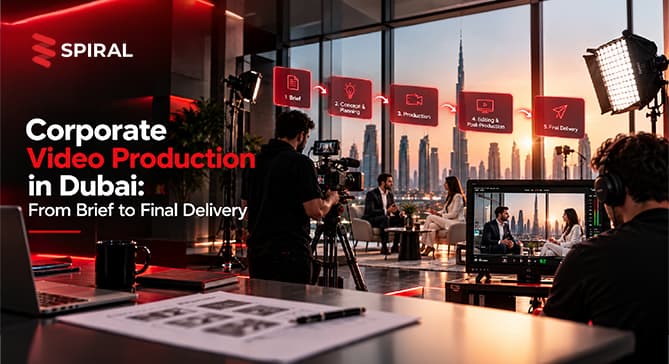
Corporate Video Production in Dubai: From Brief to Final Delivery
A corporate video can serve several purposes. It can describe the work of the company, present its workforce and processes, convey the company’s values, and help potential clients understand why they should choose this brand.
Introduction
A corporate video can serve several purposes. It can describe the work of the company, present its workforce and processes, convey the company’s values, and help potential clients understand why they should choose this brand.
However, the production of a successful corporate video is not just about placing a camera in the office and pressing the record button. Successful corporate video production requires planning before the filming, communicating everything clearly during the process, and editing once the filming is over.
If you are a company that would like to produce a corporate video in Dubai, you may find it useful to know more about the production process to know how to prepare a good brief and tips on how to make better decisions regarding production in order to make a better final video.
What Is Corporate Video Production?
The procedure of producing video content for businesses is known as corporate video production. The format can differ according to the purpose of the video. Accordingly, the company may get either a corporate profile video, a leadership message video, a product showcase video, an event video, a recruitment video, a customer story video, or a brand video.
The main thing is that the format should fit the purpose.
The corporate video made for a website can contain a brief overview of the company. The recruitment video can give more importance to the people and the company's culture. The product video can be focused on the visual demonstration of the features.
This is the reason why the production process should start with the goal of the company and not with the equipment or place of filming Adobe.
1. Start With a Clear Brief
Every corporate video project begins with a brief.
The production team will be depending on the brief to define exactly what the video needs to achieve; otherwise, the focus of the production is on making attractive footage with little concern for having a clear audience message.
A useful brief should state:
- Purpose of the video
- Target audience
- Key message
- Where the video will be shown
- Desired duration
- Key people to show
- Locations
- Expected timeframe
- Required deliverables
For example: A company reeling in corporate clients may need a video that showcases its capabilities and credibility, while a company recruiting for place needs to show its work culture and employees instead.
Such clarity of these sometimes conflicting priorities in the project makes it easier to make decisions throughout.
2. Develop the Concept and Story
After figuring out the brief, the next step is to figure out the way to convey the message.
A company video can not contain a complex subject and storyline, but it must consist of a clear text structure.
The concept should include:
- Main idea
- Story structure
- Interviews approach
- Visual approach
- Mood
- Main scenes
- Supplementary footage
The production team has to decide on the question of whether interviews, demonstrations, illustrations, graphics, and other types of visuals will serve as an efficient way of telling the story.
At this stage, it is crucial for a promotional video because the final version must connect with the brand rather than look like a typical corporate video Studiobinder).
3. Scriptwriting and Interview Preparation
Not every corporate video requires a traditional script.
While some projects are based mainly on interviews, others utilize voiceover, titles, demonstrations, or any combination of these.
If interviews are involved in the project, good preparation is necessary. While executives, employees, or clients may know a lot about the subject matter, they still need some help in expressing their ideas on camera.
The interviewer should prepare questions relevant to the purpose of the video.
For instance, instead of asking a company representative to just "talk about the company," you can inquire about what made them start the company, what problem they are solving, how their service works, etc.
This makes editing easier later.
4. Plan the Production
In the pre-production stage, various practical decisions are undertaken in preparation for the shoot.
During this phase, the production team considers possible locations, the participants, materials and equipment required, schedules and other logistical details.
For businesses engaged in corporate video production in Dubai, location planning assumes great importance.
From a production technology point of view, it is crucial for the team to know how each location is significant for the story.
The team should not select a location based on its beauty alone. The location should serve a greater purpose and help highlight some aspects of the business.
Pre-production may also include a shooting plan and a production schedule.
5. Corporate Filming
Production is the stage most people associate with video creation.
This is when the planned footage is captured.
Depending on the project, filming may include:
- Executive interviews
- Employee interviews
- Workplace activity
- Product demonstrations
- Customer interactions
- Office or facility footage
- Supporting B-roll
- Events
- Aerial footage where appropriate
Professional filming involves more than operating a camera. Lighting, sound, framing, direction, and the environment all influence the quality of the footage.
Audio deserves particular attention. A visually attractive interview can still become difficult to use if the recorded voice is unclear.
The objective is to capture enough strong material to give the editor options without creating unnecessary footage.
6. Capture Footage That Supports the Story
One of the most useful principles in corporate video production is to avoid relying entirely on talking-head interviews.
An executive might explain how a company operates, but showing the workplace, team, products, technology, or customer experience can make that explanation more engaging.
This supporting footage is often called B-roll.
For example, if a company discusses its manufacturing capabilities, the video could show the relevant processes while the speaker explains them.
If the company talks about customer service, footage of employees interacting with customers can provide visual context.
This combination of spoken information and supporting visuals can make a corporate video easier to follow.
7. Move Into Video Editing
Once filming is complete, the project moves into post-production.
This is where the recorded material is reviewed and shaped into the final story.
Video editing services can involve much more than cutting clips together. The editor may need to:
- Select the strongest takes
- Structure the story
- Remove unnecessary sections
- Improve pacing
- Synchronise sound
- Add graphics
- Add titles
- Adjust colour
- Incorporate music
- Add subtitles where required
The first edit should reflect the agreed brief and overall creative direction.
A good edit should feel intentional. Every scene should have a reason for being there.
8. Add Branding and Visual Elements
Corporate films should be in sync with the businesses they are representing.
Branding elements can be logos, fonts, colors, illustrations, product images and any other established branding tool.
Motion graphics can come in handy when the audience needs to comprehend information that is hard to convey using footage only.
For instance, sometimes statistics, timelines, processes, places, or technical details can be better explained using visual graphics.
The goal should be clarity instead of enhancing the video for the sake of complication Wistia
9. Review and Revisions
The first cut is not necessarily the final version.
Once the initial edit is ready, stakeholders should review the video against the original brief.
The review should focus on meaningful questions:
Is the main message clear?
Does the video speak to the intended audience?
Is the information accurate?
Does the visual style fit the brand?
Is the pacing appropriate?
Are there any factual or branding changes required?
A structured review process is much more effective than making random changes from multiple people without a clear decision-maker.
It is also useful to establish who has final approval before production begins.
10. Final Delivery
Upon approval of the revisions and the finalization of the video, it enters the stage of delivery.
The final files must be processed in accordance with the video application.
While a website might request a particular format, other uses for the video may require entirely different dimensions.
This is the reason why specification of delivery requirements is better carried out as part of the initial project brief.
One production can yield a main film as well as shorter clips for various channels depending on the project size.
How Long Does Corporate Video Production Take?
There is no universal timeline for a corporate video.
A short interview-based project may require considerably less production time than a larger film involving multiple locations, several participants, extensive graphics, or multiple shooting days.
The production timeline can generally be affected by:
- Complexity of the concept
- Number of filming locations
- Number of participants
- Script development
- Production days
- Editing requirements
- Motion graphics
- Number of review rounds
- Final deliverables
Planning the project properly at the beginning helps establish a realistic schedule.
Common Mistakes in Corporate Video Production
Companies may be overly concerned about how the final product will look instead of thinking through the video content.
A typical mistake is putting too many messages into one video. The best corporate videos are the ones that have a clear leading message.
Another issue lies in the absence of consultants or experts. The absence of footage, interviews, places, or approvals can lead to delays.
Another issue companies face is ignoring the needs of their audience. The audience should understand what the company wants to communicate to them, as it cannot just use its own terminology.
Finally, businesses often fail to consider the distribution before making the video. Knowing where the video will be posted will influence its length, format, structure, subtitles, etc.
Corporate Video Production in Dubai With Spiral
For businesses looking for corporate filming in Dubai, choosing a production partner that understands both the creative and strategic sides of video can make the process more organised.
Spiral provides video production services as part of its wider digital offering, with capabilities covering cinematic corporate content, commercial videos, product showcases, social media videos, event coverage, real estate videos, documentaries, and other production formats.
This broader capability can be useful when a business needs more than one type of visual content. A corporate video can be developed alongside professional photography, branding, creative copywriting, website development, or digital marketing activities, allowing different pieces of brand communication to work together.
Spiral's stated production approach covers the project from concept development through final editing, with an emphasis on creative quality and strategic effectiveness.
For a company preparing a new brand video, this means the production can be considered as part of a wider communication strategy rather than as an isolated piece of content.
Making the Most of Your Corporate Video
The strongest corporate videos usually begin with a simple question:
What should the audience understand after watching this?
Once that answer is clear, the rest of the production becomes easier to organise.
The brief establishes the objective. The concept turns that objective into a story. Pre-production prepares the people, locations and schedule. Filming captures the required material. Editing turns that material into a coherent video. Review ensures the final piece reflects the brief, and delivery prepares it for the channels where it will be seen.
Each stage contributes to the final result.
For businesses investing in corporate video production in Dubai, treating the project as a complete process rather than simply a filming day can lead to a more useful and purposeful final product.
Final Thoughts
The process of corporate video production involves a lot of planning before the actual filming. It begins with the brief, understanding the idea behind the video, planning the execution, carrying out the filming, editing the clips, and delivering the finished product.
No matter whether the purpose of a corporate video is to present the company, promote its services, advertise a product, or cover an event, the production should match the goal.
Considering the high competition in the business market of Dubai, the corporate video must be not only visually appealing but also able to convey the brand’s message correctly.
This is how an efficient production process with a skilled partner such as Spiral Media Agency can provide the company with a lot of benefits.


