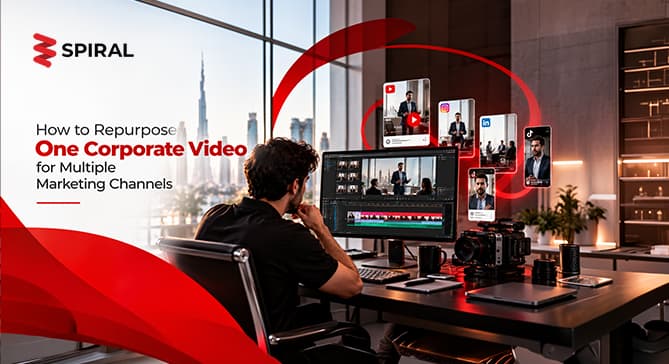
How to Repurpose One Corporate Video for Multiple Marketing Channels
One corporate video can become short-form clips, website content, email assets, LinkedIn posts, quote graphics, and more. Learn how to extract more value from a single production.
Introduction
Making, shooting, and editing a corporate film can take a lot of time and money to complete. However, putting the video on a website or social networking site does not mean it has fulfilled its purpose.
Repurposing video content is going to be more beneficial in this case. Instead of shooting each new video for every marketing channel separately, businesses can take just one good corporate film and convert it into different video types that fit each audience.
This strategy can help increase the efficiency of the video production process. Studies and specialists' recommendations on video content repurposing show that you can easily pull short clips or other videos from one filmed video without extra formatting.
What Does It Mean to Repurpose a Corporate Video?
Repurposing involves modifying an already produced video so that it can be used for a new purpose on a different platform or to target a different audience.
This is not the same as distributing the same video on multiple platforms.
For instance, a five-minute corporate video may be appropriate for a website, but the same five minutes may not work for Instagram Reels or YouTube Shorts. Instead, the different parts of the video can be picked and combined into a new video that targets the platform.
One corporate video can therefore become:
- Short-form social clips
- LinkedIn video posts
- Instagram Reels
- YouTube Shorts
- Website content
- Blog material
- Email content
- Quote graphics
- Sales presentations
- Behind-the-scenes content
The objective is not to make the audience watch the same video repeatedly. The objective is to extract useful ideas from the original production and present them in formats that make sense for each channel.
Start With a Strong Corporate Video
Effective repurposing occurs before filming begins.
When producing a corporate video, consider how video might be used later. Interviews, customer testimonials, screencasts, leadership communications, office scenes, and product footage can all provide raw material for marketing.
For example, a corporation meeting with an executive might capture not just a video of the completed interview but also multiple snippets of video that can be used independently.
In this regard, production teams would develop not only a final video but also a library of footage.
For businesses working with Spiral, this approach to planning makes the production process more efficient because it helps plan the original video shoot with future marketing needs in mind.
Turn the Main Video Into Short-Form Content
The simplest way of reusing a business video is by cutting segments from the original production.
A lengthy corporate video is likely to feature several distinct ideas, messages, demonstrations, or useful moments. These can be separated and segmented into shorter videos.
For instance, a corporate profile video could lead to producing separate clips that highlight the company's activities, the most important services provided, client problems resolved, a leadership voice, standout achievements, or behind-the-scenes shots.
AVIAN Media Network advises separating multiple video clips from the existing footage for use on multiple channels and creating various versions of the same content for different platforms Avian.
The important point is to give every short clip one clear purpose rather than trying to squeeze the entire corporate story into 30 seconds.
Create Multiple Versions From the Same Footage
You do not have to make videos that are altogether different. A single video can be adjusted into various durations based on its intended use. For example, the same product video can become:
- Long: A comprehensive video for the website or YouTube.
- Medium: An informative video for social media or LinkedIn.
- Short: A short video that highlights a single feature.
AVIAN suggests it is better to create different versions of a single content item instead of working on a different project for each platform.
Use Video Footage for Your Website
Your corporate video does not have to remain on social media.
Parts of the production can support different pages across your website. Company introductions can be placed on either the home page or about us page. Demonstrations can be on the service page, while customer interviews can be used for a case study or a testimonial section.
This helps make the videos more effective for the audience because they can deal with different aspects of the decision-making process.
Rather than containing everything in a single corporate video, you can use the appropriate sections where the video will be the most beneficial.
Turn Video Into Written Content
A corporate video may serve as a direct source for text-based materials.
An interview, educational film, or video presentation can be transcribed and then explored for its valuable concepts. These concepts may then be changed into:
- Blog entries
- LinkedIn updates
- Online articles
- Email messages
- Information to build FAQs
- Material for case studies
This is not equal to straight copying and pasting the script to share it all over. The smarter solution is to identify the most relevant information from the video and adapt it to the new format.
Thus, for example, a video interview with a key person at a company may be transformed into a blog post, several statuses for social networks, and numerous short videos. This is a great way to increase the function of video content distribution in a great information system.
Extract Quotes and Key Messages
Not every beneficial section of a corporate video has to exist as a video.
The bold words uttered by an executive, customer, worker, or expert can be converted into a text social post or a branded graphic.
For example, where a corporate video includes a speech by a leader who names several problems facing the industry, this speech may serve as a LinkedIn post. A customer's words may be converted into a testimonial graphic. Similarly, a significant figure can be transformed into a visual post.
This means the same original production can be used for different content and forms, thus avoiding a repeat feeling from the audience.
Use Behind-the-Scenes Footage
It is not necessary to include all of the video footage in the corporate video. The filming process may produce some valuable behind-the-scenes information, such as recordings of team members, locations, the filming process, interviews, and preparations.
Such videos can bring more informal content for social media. Behind-the-scenes videos can help the corporation demonstrate that there are people and additional work behind the final product creation. Therefore, having to make a professional shoot is sufficient already to allow getting behind-the-scenes footage and using it for content production.
Repurpose With a Clear Content System
The biggest mistake is treating repurposing as randomly cutting a few clips after the main video is finished. A better process is to decide the intended outputs before production.
For example:
One corporate video →
1 full-length website video
3–5 short-form clips
2–3 LinkedIn posts
1 blog article
Several quote graphics
1 email feature
The exact number will depend on the length and subject of the original video. The principle is what matters: plan the source material around its possible future uses.
Recent video-marketing guidance also recommends treating one video as a source asset that can feed social media, email, blogs, websites, and other marketing channels rather than publishing it only once Solution Labs.
Keep the Brand Consistent
Repurposing refers to using the same brand message each time. The visual identity, tone, key messages, and general positioning should be consistent in all versions. It is also important to ensure each piece is appropriate for its context.
A LinkedIn video might require an official introduction and captions, an Instagram Reel might need a short opening, while a video for the website can be longer. Hence, while the message remains constant, the execution varies.
Measure Which Versions Work
Repurposing creates another useful opportunity: learning which parts of your original video audiences respond to most.
Track relevant performance indicators for each platform, such as views, watch time, completion, clicks, engagement, or leads. If one section of a corporate video consistently performs better as a short clip, that can provide insight for future productions.
For example, if customer stories generate stronger engagement than general company introductions, future video briefs could give customer experiences a larger role.
This turns repurposing into more than a distribution tactic. It becomes a feedback loop for future content and production decisions.
How Spiral Can Help
For businesses looking to repurpose corporate video effectively, the quality and structure of the original production matter.
Spiral can support businesses through relevant video production services, helping turn a central business message into professional visual content that can be adapted for different marketing requirements.
The value is not limited to producing one finished corporate film. With the right planning, footage can support short-form video, social media content, brand communication, website material, and other marketing applications. A professional production partner can also help businesses think about framing, interviews, visuals, editing, and storytelling with future distribution in mind.
This is particularly useful when the goal is to get more value from a single production investment rather than repeatedly starting from zero.
Conclusion
When it comes to corporate videos, they should not be seen as a one-off element of a marketing strategy but as a new way to approach a video shoot.
If strategically managed, one shoot may become a source of multiple corporate videos ready for websites, social networks, and email campaigns, or even a series of short videos.
Repurposing corporate videos must be done in a wise way, not just by reposting the video. It is necessary to use the best ideas, adapting them for each channel, staying true to the brand idea, and analysing which channel provides the best results.
For companies working with Spiral, this technique is a good way to use the video production process more effectively and connect it with the distribution part of videos. If the corporate video is really powerful, it is easy to start a big content system based on it without shooting new videos.