/facebook.svg)
/linkdin.svg)
/instagram.svg)
/youtube.svg)
%2Ftwitter_x.png&w=32&q=75)

%2Fleft-header-bg-shape.png&w=3840&q=75)
%2Fright-header-bg-shape.png&w=3840&q=75)
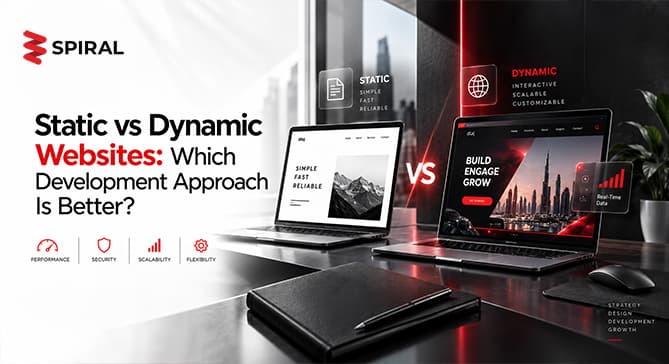
Static vs Dynamic Websites: Which Development Approach Is Better?
Static and dynamic websites support different business needs. This guide explains how they compare across performance, security, SEO, content management, functionality, scalability, and cost so businesses can choose the right development approach.
Introduction
When a company makes a decision to develop a new website, one of the first questions they will have is whether to create a static or a dynamic website.
It is important to note that the difference between both types of websites does not lay just in the appearance. It also determines how the information is provided, how frequently a certain website can be modified, what features it allows, how much maintenance work it needs, and how easily it can be adapted in case a business needs it.
There are some companies that do not need anything more than a basic static website, while others may demand constant changes. The third option is a hybrid type of development, which incorporates things from both approaches.
What Is a Static Website?
A static website consists primarily of pre-built files that are delivered to the visitor's browser.
When someone opens a page, the server does not need to generate that page from a database in real time. Instead, it delivers the prepared content.
This makes the architecture relatively simple.
Static websites are commonly suitable for:
- Company websites
- Service-based businesses
- Portfolios
- Landing pages
- Event websites
- Simple informational websites
One major advantage is performance. Since there is less server-side processing involved, static pages can be delivered quickly. They can also have a smaller technical attack surface because there are fewer server-side components and database interactions to manage. (Digipixel)
However, traditional static websites can require developer involvement when content needs to be changed. That can become inconvenient for a business that publishes new content frequently.
What Is a Dynamic Website?
A dynamic website generates or retrieves content based on a request.
Instead of simply delivering a fixed file, the system may communicate with a database, CMS, API, or other backend service before presenting the page.
This allows websites to support more complex functionality, including:
- E-commerce
- Customer accounts
- Booking systems
- Membership areas
- Personalised content
- Product catalogues
- Dashboards
- Real-time information
- Advanced forms and integrations
For instance, there might be a need for an online store to showcase various products, prices, quantities in stock, and information regarding customers. In such cases, dynamic websites are much better equipped for this kind of functionality.
Also, dynamic websites allow better content management since authorized users do not need to edit the website code, they can manage their pages, products, articles, and other pieces of information via their CMS.
A recent comparison made by Q-Tech has confirmed that a lot of cases associated with dynamic websites involve content management systems, e-commerce, memberships, dashboards, and real-time data. (Q-Tech)
Static vs Dynamic Website: The Main Differences
The choice becomes easier when you compare the two approaches according to practical business requirements.
The important point is that these are not absolute rules. Modern development tools can blur the line between static and dynamic websites.
When Does a Static Website Make Sense?
A static approach can be a practical choice when the website's main purpose is to communicate information.
For example, a professional services company may need pages for:
- About the business
- Services
- Team
- Portfolio
- Contact information
- Locations
Static architecture can give websites the desired efficiency and simplicity if those web pages do not need real-time data and detailed, intensive interaction with users.
Static sites can also suit campaign landing pages well if speed and targeted content are some of the requirements for them.
Another advantage of a simple architecture is the possibility of less ongoing technical support required for it.
But businesses must analyze their future content-related plans. If the website is supposed to become a content-rich platform or undergo frequent updates, purely static solutions can become impractical unless proper development tools are employed.
When Is Dynamic Web Development More Suitable?
Dynamic web development becomes more relevant when the website needs to perform tasks rather than simply display information.
A dynamic approach may be appropriate when a business needs:
- Online shopping
- Customer logins
- Appointment booking
- Personalised experiences
- Frequent content publishing
- Product or service databases
- Customer dashboards
- Third-party integrations
- Real-time information
Consider an e-commerce company with hundreds of products. Product information, prices, stock availability, categories, orders, and customer accounts all need to be managed.
A dynamic platform provides the underlying functionality needed to manage these processes.
The same applies to businesses that publish large amounts of content. A CMS can allow marketing teams to create and update pages without relying on developers for every small change.
Performance Is Important for Both
People think of static websites as faster options.
Although static pages do indeed perform well in comparison, as they do not go through extra processing whilst loading, this does not mean that dynamic websites are not efficient as well.
Utilising caching, CDNs, optimising images, deploying efficient coding, optimising databases, and choosing proper hosting are all effective ways to boost dynamic website performance.
Q-Tech also points out that dynamic webpages may need more optimisation, as the performance can depend on the processing performed by the server, the queries executed by the database, and the running scripts (Q-Tech)
So the development approach matters, but how the website is built and maintained matters just as much.
What About Security?
Security is another factor businesses should consider.
A traditional static website generally has fewer backend components, databases, and server-side processes. This can reduce the number of systems that need to be secured.
Dynamic websites have more components that may require ongoing attention, including CMS software, plugins, databases, APIs, forms, and application logic.
That does not mean dynamic websites are inherently insecure. Proper development, updates, access controls, monitoring, backups, and security practices can help protect both types of websites.
The difference is mainly in the amount and type of infrastructure that needs to be managed.
Static vs Dynamic Website for SEO
SEO is not limited to choosing a static or dynamic architecture.
Both can support strong organic performance when they are properly developed.
A static website can benefit from fast page delivery and a straightforward structure. A dynamic website can make it easier to manage large amounts of content, product pages, categories, and frequently updated information.
What matters is whether the architecture allows search engines to access important content effectively and whether the website provides a good experience for users.
Technical SEO elements such as:
- Page speed
- Mobile responsiveness
- Internal linking
- Crawlability
- URL structure
- Metadata
- Structured content
- Indexation
should all be considered regardless of the development approach.
This is also why website development and SEO should not be treated as completely separate projects.
What About a Hybrid Website?
Businesses do not always have to choose one approach for the entire website.
Modern development can combine static and dynamic components.
For example, a company might use highly optimised static pages for its main marketing content while using dynamic functionality for:
- E-commerce
- Booking
- Customer accounts
- Search
- Personalised content
- Interactive tools
This type of hybrid approach can provide a balance between performance and functionality.
The reference material from both Digipixel and Q-Tech discusses modern approaches that blur the traditional static-versus-dynamic distinction, including static site generators, headless CMS platforms, and hybrid architectures. (Digipixel; Q-Tech)
How Should a Business Choose?
Before selecting an architecture, businesses should answer a few practical questions:
How often will the website change?
If content is rarely updated, static may be sufficient. If teams publish content frequently, a CMS-driven dynamic approach may be more practical.
Does the website need user interaction?
Accounts, bookings, dashboards, payments, and personalisation usually point towards dynamic functionality.
How much content will the website contain?
A small company website has different requirements from a platform with hundreds or thousands of pages.
What does the business plan to add later?
A website should be designed around realistic future requirements rather than only today's needs.
Who will manage the website?
If marketing teams need to update content independently, the CMS and content-management workflow should be considered from the beginning.
How Spiral Helps Businesses Choose the Right Website Approach
The right website architecture should support the business strategy, not simply follow a development trend.
This is where Spiral's Website Development service can add value. Spiral builds performance-driven websites with attention to user interaction, functionality, and the wider digital experience. Its wider services include SEO, digital marketing, social media management, Google Ads, Meta Ads, design and branding, and creative copywriting. (Spiral)
This integrated approach is particularly useful when a new business website also needs to support search visibility, paid campaigns, branding, content, and conversion goals.
For example, the website structure can be planned alongside SEO requirements, while landing pages can be developed around paid advertising campaigns. Branding and creative content can then maintain consistency across the website and other digital channels.
Rather than choosing between static and dynamic simply because one sounds more modern, Spiral can help businesses assess their functionality, content, user experience, performance, and growth requirements before selecting an appropriate development approach.
Final Thoughts
The static vs dynamic website decision is not about finding one universal winner.
A static website can be a strong option for businesses that need a fast, focused, and relatively simple digital presence. Dynamic web development becomes more useful when a website needs frequent updates, databases, user accounts, e-commerce, personalisation, or other advanced functionality.
For some businesses, a hybrid architecture may provide the most practical balance.
The key is to start with the business requirements rather than the technology itself.
A well-planned website architecture should make the website easier to manage, support the user experience, and provide enough flexibility for the business to develop over time.
For UAE businesses planning a new website or redesign, Spiral can combine web development, SEO, digital marketing, branding, and creative services to create a digital presence built around both immediate requirements and longer-term business goals. (Spiral)



/WhatsApp.svg)