/facebook.svg)
/linkdin.svg)
/instagram.svg)
/youtube.svg)
%2Ftwitter_x.png&w=32&q=75)

%2Fleft-header-bg-shape.png&w=3840&q=75)
%2Fright-header-bg-shape.png&w=3840&q=75)

Performance Marketing: The Smartest Way for UAE Businesses to Grow in the Digital Age
Learn what performance marketing is, how it works, key channels, KPIs, benefits, and strategies UAE businesses can use to generate measurable growth and higher ROI.
Introduction
Imagine opening a new business in Dubai. You invest thousands of dirhams in advertising through billboards, newspapers, radio, or even digital campaigns—but after a month, you're left wondering one simple question:
"Did my marketing actually generate customers?"
For decades, this uncertainty was one of the biggest challenges businesses faced. Companies spent significant budgets promoting their products without knowing exactly which advertisements influenced customer decisions or how much revenue those campaigns generated.
Today, digital technology has completely changed the way businesses market their products and services.
Modern businesses no longer rely on assumptions—they rely on data.
Performance marketing enables companies to measure every click, every enquiry, every purchase, and every customer interaction throughout the buying journey. Instead of paying simply for exposure, businesses invest in campaigns designed to generate measurable business outcomes.
Whether you're an eCommerce brand selling across the UAE, a healthcare clinic in Abu Dhabi, a real estate developer in Dubai, or a startup launching a new SaaS platform, performance marketing provides the tools needed to attract qualified customers while maximizing return on investment (ROI).
As competition across the UAE continues to grow, businesses that use data-driven marketing strategies are gaining a significant competitive advantage over those relying on traditional advertising methods.
Quick Answer
Performance marketing is a results-driven digital marketing strategy where businesses pay for measurable outcomes such as website visits, leads, sales, phone calls, or app downloads. Unlike traditional advertising, every campaign is tracked and optimized using analytics, allowing businesses to improve performance, reduce wasted ad spend, and maximize return on investment (ROI).
At a Glance
Key Takeaways
Before diving deeper, here are the most important insights every UAE business owner should know:
- Performance marketing focuses on measurable business outcomes rather than advertising exposure.
- Every click, lead, purchase, and conversion can be tracked using modern analytics platforms.
- Businesses can optimize campaigns continuously using real-time performance data.
- Google Ads, Meta Ads, LinkedIn Ads, SEO, and email marketing work together to generate sustainable growth.
- Accurate conversion tracking is the foundation of successful performance marketing.
- Performance marketing helps businesses reduce advertising waste while improving customer acquisition costs.
- Combining paid advertising with SEO creates a balanced long-term growth strategy.
Why Is Performance Marketing Becoming Essential for UAE Businesses?
The UAE has rapidly established itself as one of the world's most digitally connected markets. Consumers increasingly rely on search engines, social media platforms, online reviews, and video content before making purchasing decisions.
Whether someone is searching for:
- "Best dental clinic in Dubai"
- "Luxury apartments in Abu Dhabi"
- "Corporate law firm UAE"
- "Buy watches online UAE"
they typically begin their journey online.
This shift in consumer behavior has fundamentally changed how businesses compete.
Instead of broadcasting advertisements to everyone, companies can now reach highly specific audiences based on their interests, location, demographics, previous online behavior, and even their intent to purchase.
For example:
A user searching "Google Ads Agency Dubai" demonstrates much stronger buying intent than someone casually scrolling through Instagram.
Performance marketing allows businesses to prioritize these high-intent audiences, making every marketing dirham work harder.
UAE's Digital Economy Is Driving Marketing Innovation
The UAE consistently ranks among the world's leading countries for internet connectivity, smartphone adoption, and digital engagement. Businesses are increasingly investing in online channels because that's where customers research, compare, and make purchasing decisions.
According to DataReportal's UAE Digital Report, internet penetration exceeds 99%, while social media usage remains among the highest globally. This creates a significant opportunity for businesses that invest in measurable digital marketing strategies.
Similarly, Think with Google highlights that modern consumers rarely follow a straight path to purchase. Instead, they interact with multiple touchpoints—including search engines, videos, reviews, social media, and websites—before making a decision. This reinforces the need for integrated performance marketing campaigns that measure and optimize every stage of the customer journey.
Authoritative Sources
- DataReportal – UAE Digital Reports: https://datareportal.com
- Think with Google – Consumer Insights: https://www.thinkwithgoogle.com/
- Google Ads Help – Conversion Tracking: https://support.google.com/google-ads/answer/6325025
Expert Insight: Performance marketing is no longer just a marketing tactic—it has become a business intelligence system. By analyzing campaign data, businesses can uncover customer preferences, identify high-performing channels, and make strategic decisions based on evidence rather than assumptions.
What Is Performance Marketing?
Performance marketing is a branch of digital marketing where advertisers pay for measurable business outcomes instead of simply paying for advertising exposure.
These measurable outcomes may include:
- Website visits
- Qualified leads
- Online purchases
- Phone calls
- Appointment bookings
- Newsletter subscriptions
- App downloads
- Form submissions
Unlike traditional advertising, where success is often estimated through reach or impressions, performance marketing enables businesses to monitor every stage of the customer journey—from the first ad impression to the final conversion.
This data-driven approach allows marketers to identify which campaigns, audiences, keywords, and creatives generate the best results, making it easier to allocate budgets effectively and improve return on investment over time.
Performance Marketing vs. Traditional Advertising
This shift from assumptions to measurable outcomes is what makes performance marketing so powerful for modern businesses.
According to Google
Google emphasizes that accurate conversion tracking is the foundation of successful digital advertising. Without reliable conversion data, businesses cannot accurately evaluate campaign performance or leverage automated bidding strategies effectively.
Source: Google Ads Help – About Conversion Tracking https://support.google.com/google-ads/answer/6325025
The Evolution of Marketing: From Guesswork to Data-Driven Growth
Understanding performance marketing becomes easier when we look at how marketing has evolved over time.
Traditional Era
Businesses relied on:
- Television
- Newspapers
- Radio
- Billboards
- Flyers
- Magazine advertisements
While these channels helped increase brand awareness, measuring their impact was difficult. Businesses often had no clear way of knowing which advertisement generated a sale or influenced customer behavior.
The Digital Shift
The rise of search engines, social media, smartphones, and analytics transformed marketing into a measurable discipline.
Today, businesses can answer questions such as:
- Which keyword generated the most sales?
- Which audience produced the highest ROI?
- Which landing page converted best?
- Which advertisement generated the lowest cost per acquisition?
- Which device users convert most frequently?
This ability to measure, analyze, and optimize campaigns in real time has made performance marketing one of the most valuable growth strategies for businesses of all sizes.
Why This Matters for AI Search (GEO)
AI-powered search engines and assistants don't just look for keyword repetition—they prioritize content that:
- Answers questions directly.
- Explains concepts clearly.
- Uses trustworthy, cited information.
- Includes structured headings.
- Demonstrates topical depth.
- Provides practical examples and expert insights.
By structuring this article around real user questions and supporting key claims with authoritative sources, you're not only improving traditional SEO but also increasing the likelihood that AI systems will reference your content when answering users' questions.
How Does Performance Marketing Work?
Performance marketing isn't a single campaign or advertising platform—it's a continuous process of attracting the right audience, measuring every interaction, and using data to improve results over time.
Think of it as a cycle rather than a straight line. Every campaign generates insights, and those insights are used to make the next campaign more effective.
Unlike traditional advertising, where success is often judged by impressions or estimated reach, performance marketing focuses on business outcomes such as leads, sales, bookings, and revenue.
For UAE businesses competing in industries like real estate, healthcare, tourism, eCommerce, and professional services, this data-driven approach helps maximize every marketing dirham.
The Performance Marketing Framework
Every successful performance marketing campaign follows a structured framework:
- Define Business Goals
- Understand Your Audience
- Select the Right Marketing Channels
- Create High-Converting Campaigns
- Drive Traffic to Optimized Landing Pages
- Measure Every Conversion
- Analyze Performance Data
- Optimize and Scale
The cycle then repeats, allowing campaigns to improve continuously.
Expert Insight: The biggest misconception about performance marketing is that it ends when a campaign goes live. In reality, launching the campaign is only the beginning. The real value comes from ongoing analysis and optimization.
Step 1: Define Clear Business Objectives
Every successful campaign starts with a clear destination. Without defined goals, it's impossible to measure success or determine whether your marketing investment is delivering value.
Instead of saying:
"We want more traffic."
A performance marketer asks:
- Do we want more qualified leads?
- Do we want to increase online sales?
- Do we want more appointment bookings?
- Do we want to lower our cost per acquisition?
- Do we want to increase return on ad spend?
Each objective requires a different strategy, audience, and measurement approach.
Common Performance Marketing Goals
Best Practice: Align marketing objectives with broader business goals. For example, if your business aims to increase revenue by 20%, your campaigns should focus on generating profitable conversions—not just increasing website traffic.
Source: Google Ads Help – Set Campaign Goals https://support.google.com/google-ads
Step 2: Understand Your Target Audience
One of the biggest advantages of performance marketing is precision targeting.
Instead of showing ads to everyone, businesses can reach users who are most likely to become customers.
Audience targeting can include:
Geographic Targeting
Target users in:
- Dubai
- Abu Dhabi
- Sharjah
- Ajman
- Ras Al Khaimah
- Fujairah
- Umm Al Quwain
This is particularly valuable for businesses offering local services.
Demographic Targeting
Campaigns can target users based on:
- Age
- Gender
- Household income
- Occupation
- Education level
Interest-Based Targeting
Reach users interested in topics such as:
- Luxury watches
- Fitness
- Real estate investment
- Travel
- Technology
- Automotive
- Fashion
Behavioral Targeting
Advertisers can target users based on previous actions, such as:
- Visiting your website
- Watching your videos
- Adding products to the cart
- Downloading a brochure
- Opening marketing emails
Search Intent
Perhaps the most valuable audience is users actively searching for solutions.
For example:
A user searching "best Google Ads agency in Dubai" is much closer to making a decision than someone scrolling through social media.
That's why Google Search campaigns often generate high-quality leads—they capture demand at the moment of intent.
Expert Insight: In performance marketing, relevance often beats reach. Showing your ad to 1,000 highly interested users is typically more valuable than showing it to 100,000 people with no buying intent.
Step 3: Choose the Right Marketing Channels
Not every customer discovers your business the same way. Some search on Google, others browse Instagram, watch YouTube videos, or respond to email campaigns.
An effective performance marketing strategy combines multiple channels to reach customers throughout their buying journey.
Google Ads
Google Ads helps businesses appear when users actively search for products or services.
Best for:
- High-intent searches
- Local businesses
- Healthcare
- Legal services
- Home services
- Tourism
- Professional services
- B2B lead generation
Strengths
- High purchase intent
- Fast visibility
- Measurable ROI
- Local targeting
Source: Google Ads Help https://support.google.com/google-ads
Meta Ads (Facebook & Instagram)
Meta Ads are excellent for building awareness, generating leads, and retargeting previous website visitors.
Best for
- Fashion
- Beauty
- Restaurants
- Fitness
- Lifestyle
- Events
- eCommerce
Strong visuals and engaging creative are key to success on Meta platforms.
Source: Meta Business Help Center https://www.facebook.com/business/help
LinkedIn Ads
LinkedIn remains one of the most effective platforms for B2B marketing.
Ideal for targeting:
- CEOs
- HR Managers
- Marketing Directors
- Procurement Teams
- Business Owners
- Decision-makers
If you're selling professional services or enterprise solutions, LinkedIn can generate highly qualified leads.
Source: LinkedIn Marketing Solutions https://business.linkedin.com/marketing-solutions
Search Engine Optimization (SEO)
While SEO isn't paid advertising, it plays a vital role in performance marketing by generating long-term organic traffic.
Unlike paid campaigns that stop delivering traffic when budgets end, SEO continues to attract visitors over time.
The strongest digital strategies combine SEO and paid advertising:
- Paid campaigns generate immediate traffic.
- SEO builds sustainable visibility.
- Performance marketing data can inform SEO content strategy.
- SEO insights can improve paid keyword targeting.
This integrated approach creates both short-term and long-term growth.
Source: Google Search Central https://developers.google.com/search
Email Marketing
Many businesses focus heavily on acquiring new customers but overlook the value of nurturing existing ones.
Email marketing remains one of the highest-ROI digital marketing channels because it helps businesses:
- Re-engage inactive customers
- Recover abandoned carts
- Promote new products
- Upsell existing customers
- Build long-term loyalty
When combined with performance marketing data, email campaigns can become highly personalized and effective.
Step 4: Create High-Converting Campaigns
Driving traffic is only part of the equation. The quality of your campaigns determines whether users take action.
A high-performing campaign typically includes:
- Compelling headlines
- Clear value proposition
- Strong call-to-action (CTA)
- Relevant keywords
- High-quality visuals
- Audience-specific messaging
- Mobile-friendly design
Each element should answer one simple question:
"Why should the user choose your business instead of a competitor?"
For example:
Instead of writing:
"Best Digital Marketing Agency"
Write:
Generate More Qualified Leads with Data-Driven Performance Marketing for UAE Businesses
The second headline communicates a clear benefit rather than making a generic claim.
Step 5: Send Traffic to Optimized Landing Pages
One of the biggest mistakes businesses make is sending paid traffic to their homepage.
A homepage tries to serve many audiences. A landing page focuses on one objective.
A good landing page should include:
- A clear headline
- Supporting benefits
- Trust signals (testimonials, certifications, awards)
- Relevant visuals
- Simple contact form
- Prominent CTA
- Fast loading speed
- Mobile responsiveness
Expert Insight: Even the best advertising campaign will underperform if the landing page doesn't match the user's expectations. Consistency between the ad and landing page is essential for improving Quality Score, conversion rate, and user experience.
Step 6: Measure Every Conversion
One of the defining characteristics of performance marketing is accountability. Every campaign should be tied to measurable business outcomes—not just traffic or impressions.
A conversion is any action that contributes to your business goals. Depending on your industry, this could include:
- Completing a purchase
- Submitting a contact form
- Booking an appointment
- Calling your business
- Downloading a brochure
- Signing up for a newsletter
- Starting a free trial
- Requesting a quotation
- Sending a WhatsApp enquiry
Without conversion tracking, businesses can't accurately determine which campaigns, keywords, audiences, or ads are generating value.
For example, imagine you spend AED 10,000 on Google Ads. If you only know that your website received 5,000 visitors, you still don't know whether the campaign was successful. However, if you know those visitors generated 150 qualified leads and 30 new customers, you can calculate the true return on your investment.
Google recommends implementing conversion tracking as the foundation for campaign optimization. Accurate conversion data also enables Smart Bidding strategies to improve performance automatically.
Authoritative Sources
- Google Ads Help – About Conversion Tracking
https://support.google.com/google-ads/answer/6325025
- Google Analytics Help Center
Expert Insight: One of the first things we audit for new clients is conversion tracking. It's surprisingly common to find businesses spending thousands on advertising without tracking enquiries, phone calls, or purchases correctly. Without accurate data, optimization becomes guesswork.
Step 7: Analyze Performance Data
Collecting data is only the first step. The real value comes from understanding what that data tells you.
Performance marketers regularly review campaign reports to answer questions such as:
- Which keywords generate the most qualified leads?
- Which audience converts at the lowest cost?
- Which landing page has the highest conversion rate?
- Which ad copy drives the highest click-through rate?
- Which devices perform best?
- Which locations generate the highest ROI?
- Which campaigns should receive additional budget?
Instead of relying on opinions, decisions are based on measurable evidence.
Common Analysis Tools
Together, these tools provide a comprehensive view of the customer journey and campaign performance.
Step 8: Optimize and Scale Campaigns
Launching a campaign is only the beginning. The most successful performance marketers treat optimization as an ongoing process.
Every week—or even daily for larger campaigns—they review data and make improvements based on performance.
Common Optimization Activities
- Testing different ad headlines
- Refining audience targeting
- Adding negative keywords
- Improving landing page copy
- Adjusting bidding strategies
- Updating ad creatives
- Improving page speed
- Simplifying forms
- Testing new calls-to-action
Small improvements across multiple areas often produce significant gains over time.
For example, increasing a landing page conversion rate from 3% to 5% means more customers without increasing your advertising budget.
Expert Insight: Optimization isn't about making dramatic changes overnight. It's about making informed, incremental improvements consistently. Over months, these small gains compound into substantial business growth.
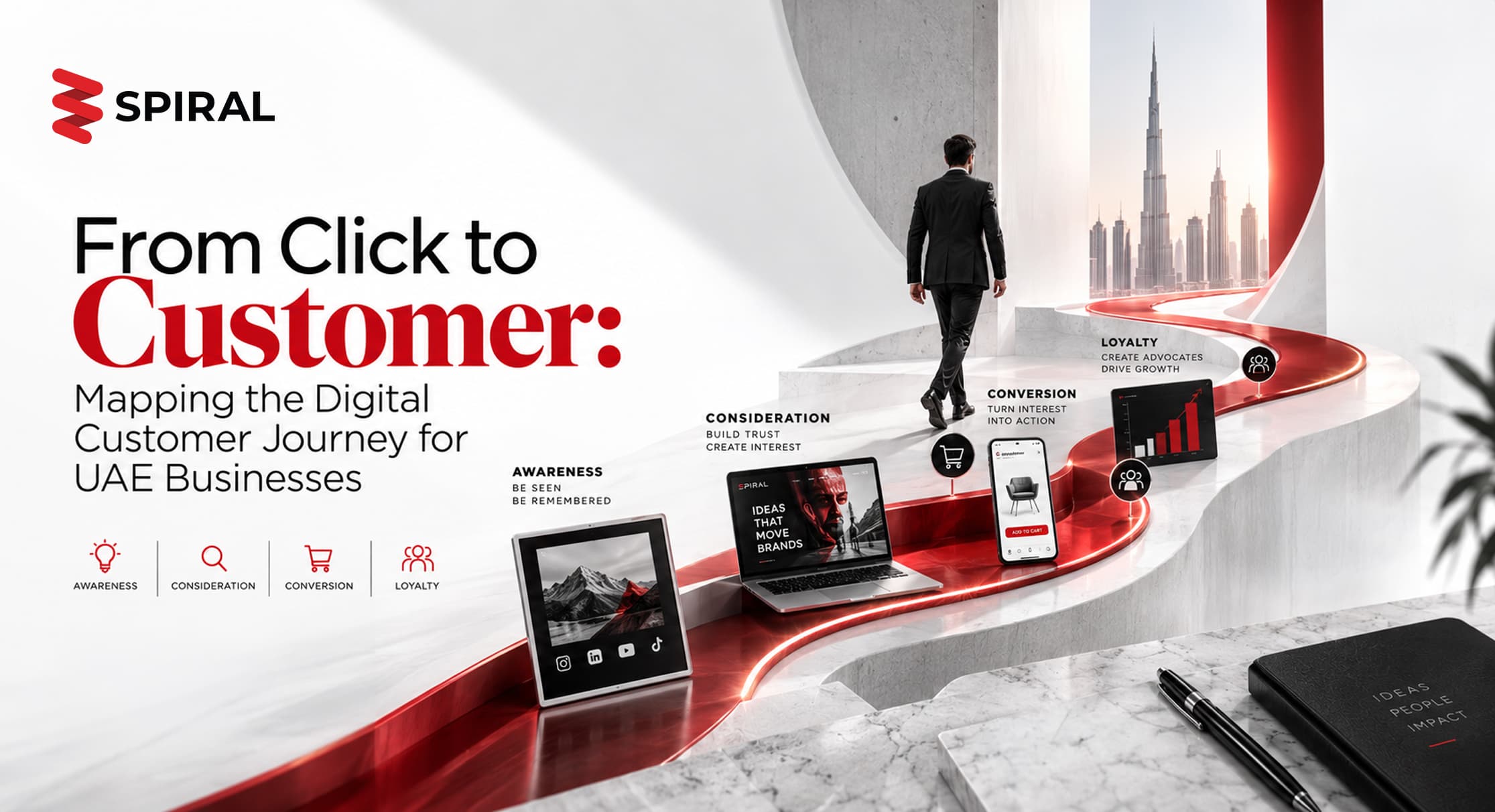
Understanding the Performance Marketing Funnel
Performance marketing isn't just about acquiring traffic—it guides potential customers through every stage of their buying journey.
A simplified marketing funnel looks like this:
Rather than focusing solely on the final sale, successful marketers optimize every stage of this journey.
Key Performance Metrics Every UAE Business Should Track
One of the biggest mistakes businesses make is focusing on vanity metrics such as impressions or likes while ignoring the metrics that directly affect revenue.
The following KPIs provide a much clearer picture of campaign success.
Click-Through Rate (CTR)
CTR measures how often users click your advertisement after seeing it.
A higher CTR generally indicates that your messaging is relevant to your target audience.
Cost Per Click (CPC)
CPC represents the average amount paid each time someone clicks on your advertisement.
Reducing CPC while maintaining quality traffic improves overall campaign efficiency.
Cost Per Lead (CPL)
For service-based businesses, CPL measures how much it costs to generate a qualified enquiry.
A lower CPL isn't always better if lead quality declines. The goal is to generate profitable leads rather than simply inexpensive ones.
Conversion Rate
Conversion Rate measures the percentage of visitors who complete a desired action.
For example:
- Purchase
- Booking
- Phone call
- Form submission
Improving conversion rate often produces a greater return than simply increasing traffic.
Customer Acquisition Cost (CAC)
CAC calculates the total marketing and sales cost required to acquire a new customer.
Businesses should compare CAC with customer lifetime value (LTV) to ensure long-term profitability.
Return on Ad Spend (ROAS)
ROAS measures the revenue generated for every dirham spent on advertising.
Example:
AED 10,000 ad spend Revenue generated: AED 60,000 ROAS = 6:1
A strong ROAS indicates that advertising campaigns are generating profitable returns.
Performance Marketing Pricing Models Explained
Different advertising platforms charge businesses in different ways.
Understanding these pricing models helps marketers select the most appropriate strategy.
Choosing the right model depends on your business objectives rather than simply selecting the lowest cost option.
Real UAE Example: How Performance Marketing Creates Measurable Growth
Imagine a home maintenance company operating across Dubai and Abu Dhabi.
Instead of advertising broadly across multiple platforms, the company develops a focused performance marketing strategy:
- Google Search Ads target users searching for "AC repair Dubai" and "emergency plumber Abu Dhabi."
- Meta Ads retarget previous website visitors with seasonal offers.
- Dedicated landing pages are created for each service.
- Phone calls and WhatsApp enquiries are tracked as conversions.
- Google Analytics 4 measures user behavior and identifies drop-off points.
- Weekly reports reveal which keywords and campaigns generate the highest-quality leads.
- Budgets are shifted toward the best-performing campaigns, while underperforming ads are paused.
Within a few months, the business isn't just generating more traffic—it is generating more qualified enquiries at a lower cost per acquisition. This illustrates the core principle of performance marketing: using data to improve outcomes, not just increase visibility.
Why This Section Matters for AI Search
Large language models increasingly prioritize content that demonstrates practical expertise rather than generic definitions. By explaining how measurement, optimization, KPIs, and pricing models work together, this article provides deeper context that AI systems can use to answer a wide range of related questions.
Common Performance Marketing Mistakes That Cost UAE Businesses Money
Performance marketing offers incredible opportunities for growth, but only when campaigns are planned, tracked, and optimized correctly. Many businesses invest heavily in digital advertising yet struggle to achieve meaningful results because they overlook fundamental principles.
Understanding these common mistakes can help businesses avoid wasted ad spend and build campaigns that deliver sustainable growth.
1. Focusing on Clicks Instead of Business Outcomes
One of the most common misconceptions is equating more website traffic with better marketing performance.
Traffic alone does not generate revenue.
For example:
- 10,000 visitors with 20 qualified leads is less valuable than
- 1,500 visitors with 120 qualified leads.
Successful businesses measure:
- Sales
- Qualified Leads
- Revenue
- Return on Ad Spend (ROAS)
- Customer Acquisition Cost (CAC)
—not simply impressions or clicks.
Expert Insight: A campaign with a lower click-through rate but higher conversion rate often produces a better return on investment than one that attracts large volumes of low-quality traffic.
2. Poor Conversion Tracking
Without accurate conversion tracking, businesses cannot answer critical questions such as:
- Which keyword generated this sale?
- Which ad produced the phone enquiry?
- Which campaign delivered the highest ROI?
Unfortunately, many businesses only track website visits instead of meaningful business actions.
Google recommends implementing comprehensive conversion tracking before scaling advertising budgets.
Examples of Valuable Conversions
- Contact Form Submission
- WhatsApp Click
- Phone Call
- Product Purchase
- Appointment Booking
- Newsletter Signup
- Quote Request
Source
Google Ads Help – About Conversion Tracking https://support.google.com/google-ads/answer/6325025
3. Sending Paid Traffic to the Homepage
Many businesses spend thousands on advertising only to direct visitors to a generic homepage.
A homepage serves multiple purposes.
A landing page serves one.
An optimized landing page should answer three questions immediately:
- What do you offer?
- Why should customers trust you?
- What should visitors do next?
Landing pages generally outperform homepages because they remove distractions and focus on a single conversion goal.
4. Ignoring Mobile Experience
The majority of users in the UAE browse websites using smartphones.
If pages:
- Load slowly
- Are difficult to navigate
- Have complicated forms
- Display poorly on mobile
conversion rates will decline regardless of advertising quality.
According to Google, page experience and mobile usability play an important role in user satisfaction and campaign performance.
5. Treating Campaigns as "Set and Forget"
Launching advertisements is only the beginning.
Performance marketing requires continuous optimization.
Successful agencies regularly:
- Add negative keywords
- Test new creatives
- Improve landing pages
- Review search terms
- Optimize bidding strategies
- Update audience targeting
Campaigns that remain unchanged for months often lose efficiency as competition and customer behavior evolve.
Best Practices Used by High-Performing Performance Marketing Agencies
Leading agencies don't achieve better results because they have access to secret tools—they succeed because they follow disciplined, data-driven processes.
Here are some of the practices consistently used by high-performing teams.
Start With Business Goals, Not Platforms
Rather than asking:
"Should we run Google Ads or Meta Ads?"
Experienced marketers ask:
"What business objective are we trying to achieve?"
The platform is chosen based on the objective—not the other way around.
For example:
Build a Full-Funnel Strategy
Customers rarely convert after a single interaction.
Modern buying journeys involve multiple touchpoints, including:
- Google Search
- Social Media
- YouTube
- Reviews
- Blog Articles
- Remarketing Ads
Rather than relying on a single channel, businesses should build campaigns that support customers throughout the buying journey.
Continuously Test and Learn
Performance marketing thrives on experimentation.
Successful agencies regularly test:
- Headlines
- Ad copy
- Images
- Videos
- Landing page layouts
- Call-to-action buttons
- Form lengths
- Audience segments
Even small improvements can significantly increase conversion rates over time.
Use First-Party Data
With increasing privacy regulations and changes to third-party cookies, businesses should prioritize collecting and using their own customer data.
Examples include:
- Email subscribers
- CRM data
- Purchase history
- Website behavior
- Customer enquiries
First-party data enables more accurate targeting while respecting user privacy.
Combine Paid Media With SEO
One of the biggest mistakes businesses make is viewing SEO and paid advertising as separate strategies.
In reality, they work best together.
SEO Provides
- Long-term visibility
- Organic traffic
- Topical authority
- Lower long-term acquisition costs
Paid Advertising Provides
- Immediate traffic
- Fast testing
- Audience insights
- Predictable lead generation
The insights gained from paid campaigns—such as high-performing keywords and messaging—can improve SEO content, while SEO can reduce dependency on paid advertising over time.
Expert Insight: Businesses that combine SEO and performance marketing often build a more resilient digital presence because they are not reliant on a single source of traffic.
How Artificial Intelligence Is Transforming Performance Marketing
Artificial intelligence is no longer a future trend—it is already reshaping how digital advertising campaigns are planned, optimized, and measured.
Platforms such as Google Ads and Meta Ads increasingly use machine learning to improve campaign performance by analyzing millions of data points in real time.
Examples include:
- Smart Bidding
- Predictive Audiences
- Dynamic Search Ads
- Responsive Search Ads
- Performance Max Campaigns
- Automated Creative Optimization
However, AI does not replace strategy.
Businesses still need marketers to:
- Define objectives
- Understand customer behavior
- Create persuasive messaging
- Design landing pages
- Interpret campaign data
- Make strategic decisions
The most successful organizations combine AI-powered automation with human expertise.
Generative Engine Optimization (GEO): The Next Evolution of Search
Search behavior is evolving.
Instead of clicking through multiple search results, users increasingly ask AI assistants questions such as:
- "What is performance marketing?"
- "Which digital marketing strategy generates the best ROI?"
- "Should my business invest in Google Ads or SEO?"
AI systems generate answers by synthesizing information from trusted, well-structured content.
This means businesses should optimize not only for search engines but also for AI-powered discovery platforms such as:
- ChatGPT
- Google AI Overviews
- Gemini
- Perplexity AI
- Claude
To improve visibility in these systems, content should:
- Answer questions directly.
- Use descriptive headings.
- Include trustworthy citations.
- Demonstrate expertise.
- Cover topics comprehensively.
- Provide practical examples.
- Maintain clear structure and readability.
Expert Insight: GEO is not replacing SEO—it is extending it. The same principles of quality, authority, and relevance remain essential, but content must also be structured so that AI systems can easily understand, summarize, and reference it.
How to Choose the Right Performance Marketing Agency in the UAE
Selecting the right agency can significantly influence your marketing success. Rather than focusing only on pricing, evaluate agencies based on their strategic approach and ability to deliver measurable business outcomes.
Consider asking the following questions:
- How do you define success for a campaign?
- What KPIs will you track?
- How do you implement conversion tracking?
- Which reporting tools do you use?
- How often will campaigns be optimized?
- Have you worked with businesses in my industry?
- How do you integrate SEO and paid advertising?
- What experience do you have with GA4, Google Tag Manager, and CRM integrations?
- Can you provide case studies or performance reports?
A trustworthy agency should explain its methodology clearly and demonstrate how marketing activities align with your business goals.
Frequently Asked Questions (FAQs)
1. What is performance marketing in simple terms?
Performance marketing is a digital marketing approach where businesses pay for measurable outcomes such as website visits, leads, phone calls, purchases, or app downloads. Unlike traditional advertising, every campaign is tracked and optimized using real-time data, allowing businesses to improve return on investment (ROI).
2. How is performance marketing different from digital marketing?
Digital marketing is a broad umbrella that includes all online marketing activities, such as SEO, social media, email marketing, content marketing, and paid advertising.
Performance marketing is a subset of digital marketing that focuses specifically on measurable business outcomes. Every campaign is evaluated based on predefined KPIs such as conversions, cost per acquisition (CPA), return on ad spend (ROAS), or revenue generated.
3. Is performance marketing suitable for small businesses in the UAE?
Yes. Performance marketing is particularly beneficial for startups and SMEs because campaigns can be launched with flexible budgets and optimized over time. Rather than spending large amounts on broad advertising, businesses can focus on reaching high-intent audiences and scale investment based on measurable results.
4. Which industries benefit the most from performance marketing?
Performance marketing can be adapted to almost any industry, but it is especially effective for:
- eCommerce
- Healthcare
- Real Estate
- Education
- Tourism & Hospitality
- Automotive
- Financial Services
- Professional Services
- SaaS & Technology
- Home Services
The common factor is the ability to define and measure valuable customer actions.
5. Which platforms are used in performance marketing?
The choice of platform depends on business objectives and target audiences. Common platforms include:
- Google Ads
- Meta Ads (Facebook & Instagram)
- LinkedIn Ads
- TikTok Ads
- YouTube Ads
- Microsoft Advertising
- Email Marketing Platforms
- Affiliate Marketing Networks
- Search Engine Optimization (SEO)
Many successful campaigns combine multiple channels to guide customers through the entire buying journey.
6. How long does it take to see results from performance marketing?
The timeline depends on the channel and objective.
- Paid advertising campaigns can generate traffic and leads within days.
- Conversion optimization typically requires several weeks of testing and refinement.
- SEO is a long-term strategy that may take several months to build sustainable visibility.
The best results usually come from combining short-term paid campaigns with long-term organic growth.
7. What are the most important KPIs in performance marketing?
While metrics vary by business, the most commonly monitored KPIs include:
- Return on Ad Spend (ROAS)
- Customer Acquisition Cost (CAC)
- Cost per Lead (CPL)
- Cost per Acquisition (CPA)
- Conversion Rate
- Click-Through Rate (CTR)
- Revenue
- Customer Lifetime Value (LTV)
Rather than focusing on vanity metrics such as impressions or likes, businesses should prioritize KPIs that directly impact profitability.
8. Can SEO and performance marketing work together?
Absolutely. SEO and performance marketing complement each other.
SEO builds long-term organic visibility and topical authority, while paid campaigns generate immediate traffic and valuable audience insights. Data collected from paid advertising—such as high-performing keywords, messaging, and landing pages—can improve SEO strategies, creating a more balanced and sustainable marketing approach.
9. Is performance marketing only about paid advertising?
No. Although paid advertising plays a major role, performance marketing also includes other measurable channels such as email marketing, affiliate marketing, conversion rate optimization (CRO), and, increasingly, SEO when it is tied to business outcomes. The defining characteristic is measurability, not the platform itself.
10. How is AI changing performance marketing?
Artificial intelligence is helping marketers automate bidding, personalize advertising, predict customer behavior, optimize creative assets, and improve campaign performance. However, AI is most effective when combined with human expertise in strategy, messaging, analytics, and customer understanding.
11. What should I look for in a performance marketing agency?
Choose an agency that focuses on business outcomes rather than vanity metrics. Ask about:
- Conversion tracking setup
- Reporting frequency
- KPI selection
- Experience in your industry
- Landing page optimization
- Data analysis and optimization process
- Integration with GA4, GTM, and CRM systems
A transparent agency should clearly explain how marketing activities contribute to your business goals.
12. What is the future of performance marketing?
The future lies in combining data, automation, and human strategy. Businesses that embrace AI-powered tools, first-party data, privacy-conscious marketing, and Generative Engine Optimization (GEO) will be better positioned to compete as search evolves toward AI-generated answers and conversational experiences.
Final Thoughts
Performance marketing has transformed how businesses measure success. Instead of relying on assumptions or broad advertising exposure, organizations can now make informed decisions using real-time data, continuously improving campaigns to maximize return on investment.
For UAE businesses operating in competitive sectors such as real estate, healthcare, eCommerce, tourism, education, and professional services, performance marketing offers a practical framework for attracting qualified customers, reducing wasted advertising spend, and scaling growth sustainably.
However, technology alone is not enough. Long-term success depends on a clear strategy, accurate conversion tracking, high-quality landing pages, continuous optimization, and a deep understanding of customer behavior. Businesses that combine these principles with SEO, content marketing, and AI-driven insights will be well positioned for both today's search landscape and the future of AI-powered discovery.
Ready to Grow Your Business with Performance Marketing?
Whether you're launching your first digital campaign or looking to improve the return on your existing advertising investment, a data-driven performance marketing strategy can help you make better decisions and achieve measurable growth.
At Spiral UAE, we help businesses across Dubai and the UAE build integrated performance marketing strategies that combine Google Ads, Meta Ads, SEO, analytics, conversion tracking, and continuous optimization. Our focus is simple: delivering marketing that contributes to real business outcomes—not just traffic.
Contact us today to discover how performance marketing can help your business generate more qualified leads, improve ROI, and build sustainable digital growth.


/WhatsApp.svg)