






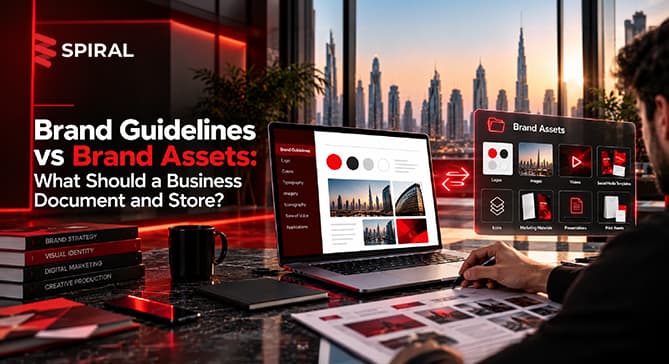
Brand Guidelines vs Brand Assets: What Should a Business Document and Store?
Brand guidelines explain how to represent a brand, while brand assets are the files and materials people need to bring it to life. Learn what to document, what to store, and how to keep both organised.
Introduction
A business can create a great logo, use various colours, have selected fonts, and produce well-made advertising material. However, without a proper system to manage them, a business can quickly become inconsistent.
Specifically, one designer can apply an old logo. A social media manager can pick an inappropriate font. A print shop can receive a low-resolution picture instead of the right production file. Thus, these minor things may contribute to a different perception of a business over time.
This is where it is essential to understand the difference between brand guidelines and brand assets. Brand guidelines explain how to represent a brand, while brand assets include the actual materials that will help make that representation MAstratos.
For businesses working with multiple designers, marketers, agencies, printers, and other partners, keeping both organised can make everyday brand management much easier.
What Are Brand Guidelines?
Brand guidelines are a collection of rules that detail how a company should present its brand.
These may include visual elements such as:
- Logo usage
- Brand colours
- Typography
- Photography
- Illustrations
- Icons
- Layouts
- Graphic styles
Depending on the business, it may also be necessary to define written aspects of the brand, including tone of voice and messaging.
The brand guidelines aim at not only describing what the brand looks like but also explaining how its parts are to be used together.
For example, a logo guideline may explain which version of the logo should be used on a dark background, how much clear space should surround it, and what minimum size should be maintained.
Similarly, colour guidelines can specify exact colour values rather than simply saying "use blue."
This makes the document useful when different people create materials for the same business.
What Are Brand Assets?
Brand assets are materials that help businesses create their branded items, as well as everything a company has, which can be as follows:
- Logo files
- Logo variations
- Files or information that consist of font types
- Colour specifications
- Icons
- Illustrations
- Photography
- Video files
- Social media templates
- Presentation templates
- Marketing templates
- Brand graphics
For example, an SVG logo is a brand asset, while the guidelines document that provides users with information about how to use this SVG logo is something entirely different.
The distinction is very simple, yet significant.
Having a collection of logo files does not mean that people will know what version to use and how much space should be left around the logo. At the same time, the guidelines document will indicate that.
An effective brand asset library can consist of various formats of logos such as SVG, PNG, EPS, and PDF, along with fonts, colors, templates, and visual materials that should be used Evoke Studio.
Brand Guidelines vs Brand Assets: The Main Difference
The easiest way to understand brand guidelines and assets is to think of them as instructions and resources.
Brand guidelines = rules
They tell people how to use the identity.
Brand assets = files
They give people the actual materials they need to create branded content.
For example:
A business normally needs both.
Having only guidelines can make execution difficult because people may know the rules but not have easy access to the correct files. Having only assets creates another problem: people have the files but may not know how to use them correctly.
What Should a Business Document in Its Brand Guidelines?
A brand guideline document should contain the information that people need to make consistent decisions.
1. Brand Foundation
Start with the basics.
This can include the brand's purpose, values, personality, audience, and positioning. Not every business needs an extensive strategy document inside its guidelines, but a short explanation can help designers and marketing teams understand the thinking behind the visual identity.
This is particularly useful when new team members or external partners start working with the brand.
2. Logo Rules
Logo usage is one of the most important parts of visual identity guidelines.
Document:
- Primary logo
- Secondary logo versions
- Icon or symbol
- Black and white versions
- Minimum size
- Clear space
- Approved backgrounds
- Incorrect uses
The guideline should make it obvious which logo to use in different situations.
It should also show what not to do, such as stretching, rotating, changing the colours, or placing the logo over a background that makes it difficult to read.
3. Colour Palette
Companies should clarify their approved colour concepts with the use of precise details.
Depending on where the colour will be applied, it may include the HEX, RGB, CMYK, or Pantone values.
This is important because telling the designer to "use our blue" can be misinterpreted in many ways.
Precise colour specifications make it possible for all people concerned to achieve a unified visual identity on websites, social media, print-outs, presentations, signboards, and other platforms Shopify.
4. Typography
Typography should also be documented.
The guidelines can identify:
- Primary typeface
- Secondary typeface
- Heading styles
- Body text styles
- Font weights
- Sizes
- Spacing
- Digital alternatives where required
This helps prevent situations where every designer chooses a different font or formatting style.
5. Imagery and Graphic Style
If the brand strongly emphasizes the significance of photography, illustrations, icons, or graphics, provide details about their look and feel.
For instance, one brand may prefer using real-life photographs rather than heavily edited stock images. On the contrary, another brand may want to have simple illustrations and minimal graphics.
These guidelines need to provide enough information so that anyone without knowledge of the brand could grasp the intended visual concept.
6. Tone of Voice
A complete brand system does not necessarily stop at visual identity.
If multiple people write for the business, guidelines can also explain how the brand should sound.
This can cover:
- Formal or casual language
- Words the brand prefers
- Words to avoid
- Sentence style
- Communication principles
- Examples of suitable messaging
This helps maintain consistency between what the brand looks like and how it communicates. Comprehensive brand guides commonly include both visual and verbal elements. The Brand Protocol
Which Brand Assets Should a Business Store?
Once the rules are documented, the actual files should be stored somewhere easy to access.
Logo Files
Do not keep just one logo image.
Depending on the business's needs, the asset library may include:
- SVG
- PNG
- EPS
- Horizontal version
- Stacked version
- Icon-only version
- Light version
- Dark version
Different formats are useful for different applications.
A website developer may need an SVG, while a printer may request a suitable print-ready format.
Fonts
Keep the approved font information together with any relevant font files and licensing details.
This is especially important when external designers or agencies work on the brand.
Colour References
Store the approved colour values alongside the guidelines so users do not have to search through old designs to find the correct specifications.
Templates
Templates can include:
- Presentation decks
- Social media layouts
- Documents
- Business cards
- Reports
- Advertising formats
- Email signatures
Templates can make it easier for teams to produce everyday materials without creating the design from scratch each time.
Photography and Video
If the business has approved photography, product images, corporate videos, or other visual content, these should have a clear home in the asset library.
Keeping original and approved versions organised can prevent teams from repeatedly downloading compressed images from social platforms or websites.
How Should Brand Assets Be Organised?
A brand library is only useful when people can actually find what they need.
A simple folder structure might look like:
01 — Brand Guidelines The latest approved guidelines.
02 — Logos All approved logo versions and formats.
03 — Fonts Approved typefaces and licensing information.
04 — Colours Colour references and specifications.
05 — Photography Approved images and original files.
06 — Icons & Illustrations Approved graphic elements.
07 — Templates Presentation, social, document, and marketing templates.
08 — Archive Older versions that should no longer be used.
File naming also matters. Names such as Logo_Final_Final2.png make asset management difficult. Clear names that describe the asset and version are much easier for teams to understand.
Why Brand Consistency Matters
Brand consistency is more than just creating good-looking designs.
It helps customers see the same identity reflected in communications from different channels.
Above everything else, it becomes more relevant since companies with an increasing number of communications and touchpoints keep on growing.
Each team may create different documents: the marketing team develops social media content, the sales team works on presentations, while an advertising agency creates ads. If there are no established rules and resources approved by the company, each team can come up with its own peculiar version of the brand, which is definitely not good.
Brand guidelines are the rules, and the asset library is concerned with the provision of the approved materials needed for compliance with these rules.
Common Mistakes Businesses Make
Several problems appear when guidelines and assets are not managed properly.
Keeping Everything in One Folder
Putting logos, old designs, fonts, templates, and unrelated files into one folder makes finding the correct resource difficult.
Using Outdated Logo Files
Old logos can continue circulating among employees and external partners long after a rebrand.
Providing Rules Without Files
A guideline PDF may say exactly which logo to use, but if the correct logo file is difficult to find, people may use whatever version is available.
Providing Files Without Rules
The opposite problem is equally common. A folder full of logos and graphics does not explain which version should be used or where.
Not Updating the System
Brand guidelines and assets should evolve when the identity changes. A new logo, colour, typeface, template, or channel may require an update.
How Spiral Can Help Businesses Manage Their Brand
If companies desire to build their branding systematically and consistently, Spiral can provide them with the relevant branding and creative services.
Rather than treating the logo as the whole brand, companies can take a holistic view of branding where the visual direction, assets, and consistent application come into more integral use.
This is especially useful in periods when companies are expanding, and their branding requires their business to be present on websites, social networks, presentations and activities, print ads, and all points of contact with customers.
With adequate support in branding, businesses can receive proper visual identity and develop the means necessary for both members of their in-house team and third parties to be able to present their brand in the same way.
When companies want to create their branding assets, professional support will help ensure that all brand elements form a holistic visual system.
A Practical Brand Management Checklist
Before considering your brand system complete, check whether you have:
- A current version of your brand guidelines
- Approved logo variations
- Correct logo file formats
- Colour specifications
- Typography information
- Approved imagery direction
- Icon and illustration resources
- Templates for frequently used materials
- Tone-of-voice guidance where required
- A clearly organised asset library
- An archive for outdated materials
- A process for updating the guidelines and files
This creates a much more usable system than simply keeping a logo and a PDF somewhere on a shared drive.
Final Thoughts
Branding guidelines and brand assets differ simply: guidelines state the rules, while assets offer the useful tools.
An organization should explain how its logo, colors, font, visual elements, slogans, etc. work. The appropriate files have to be gathered in a systematic and organized brand library.
The two go hand in hand.
If one does not have the needed assets, they will not be able to fulfill the work properly. If one has a lot of assets without the proper guidelines, there will be no consistency in the work.
With both aspects organized as they should be, designers, marketers, and other parties will have clarity of mind in their work.