/facebook.svg)
/linkdin.svg)
/instagram.svg)
/youtube.svg)
%2Ftwitter_x.png&w=32&q=75)

%2Fleft-header-bg-shape.png&w=3840&q=75)
%2Fright-header-bg-shape.png&w=3840&q=75)
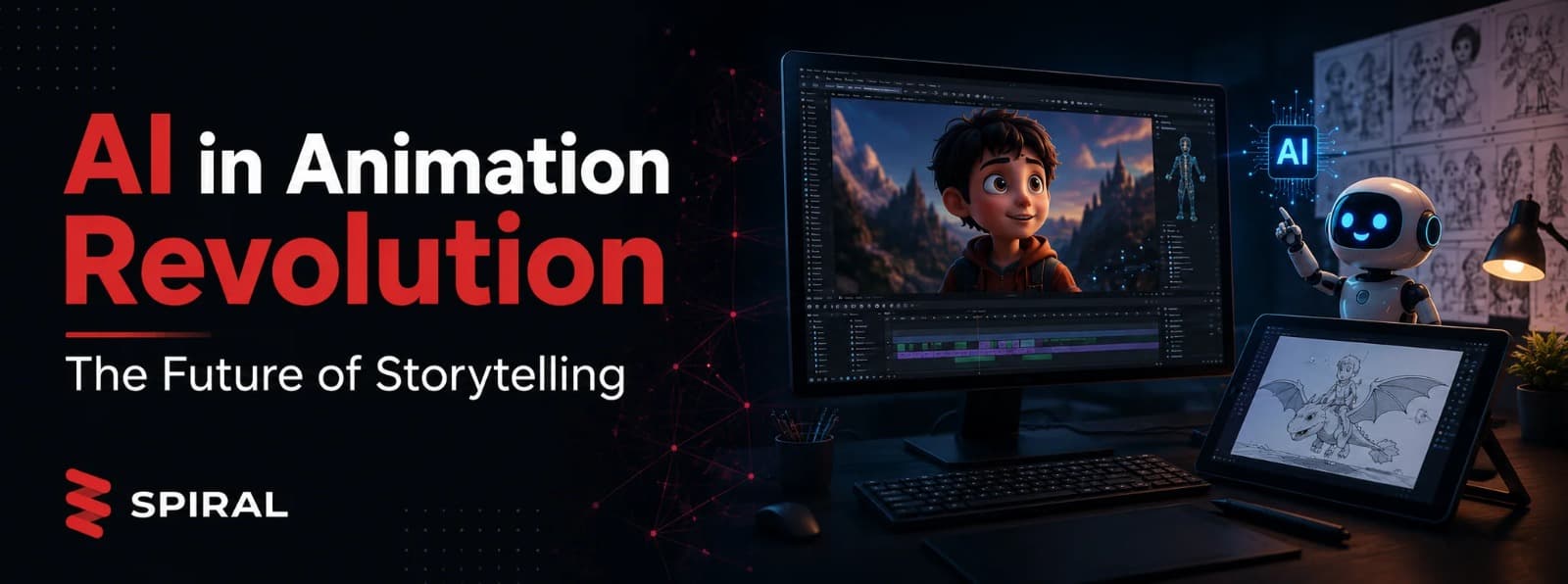
How Is AI in Animation Revolutionizing the Future of Storytelling?
Discover how AI is transforming animation and storytelling with faster production, smarter workflows, and limitless creative possibilities for creators.
What is AI in Animation?
The integration of AI into animation is reshaping the landscape of content creation, enhancing efficiency, creativity, and scalability by leveraging the power of AI alongside traditional animation methods. AI is not a replacement for artists, but rather a tool that can help in various stages of the animation production process, freeing up time for creative teams to devote to storytelling and artistic decisions. Using AI technologies can enhance the efficiency of animation production and streamline complex processes (Source: MDPI). We believe AI is most valuable as a creative partner that helps storytellers work more efficiently while preserving originality and artistic vision.
Why AI is Revolutionizing Storytelling?
AI is revolutionizing storytelling by streamlining repetitive production processes and allowing creators to dedicate more time to brainstorming, emotions and audience interaction. The demand for quality video content continues to rise both on websites and social media platforms and in digital advertising, and creative teams want more efficient and faster production processes. Generative AI's potential is to enhance productivity by automating labor-intensive tasks and assisting in creative processes across various sectors (Source: McKinsey). At Spiral, we believe the future of storytelling lies in combining human imagination with AI-powered efficiency to create meaningful content for today’s fast-moving digital landscape.
How AI is Transforming the Animation Process?
AI is improving the animation process from initial concept to final production by making creative workflows faster and more efficient. Rather than replacing designers, writers, and animators, AI can support professionals by automating repetitive tasks and assisting with different stages of content creation. Generative AI can create and refine content such as text, images, and other media, demonstrating its growing role in supporting modern creative workflows (Source: IBM). As the AI in Animation Industry evolves, we believe combining AI with human expertise will help businesses scale content production while maintaining creativity, consistency, and audience impact.
How Does AI Support Script?
AI is enhancing script development through its ability to brainstorm ideas, organize stories, and provide creative solutions more effectively. With the increasing demand for content creation, AI tools can assist with brainstorming, plotting out story ideas, and the initial stages of writing, allowing creative teams to take the time to enhance their stories. There is potential for generative AI tools to enhance performance and productivity by assisting human workers (Source: nngroup). We believe AI should act as a creative collaborator that helps storytellers work faster while preserving the emotional depth, authenticity, and strategic thinking behind compelling stories.
How Does AI Help with Storyboarding?
AI is streamlining storyboarding by turning written ideas and scripts into visual concepts that support faster animation pre-production. As storyboards help define camera angles, character movements, and scene transitions, creating them early allows teams to refine ideas and reduce unnecessary revisions during production. Generative AI can support creative workflows by helping professionals ideate, explore concepts, and accelerate content creation (Source: MDPI). We believe AI-assisted storyboarding can improve collaboration and project efficiency while ensuring that designers and creative teams maintain control over the final artistic vision.
How Does AI Improve Character Design?
AI is enhancing character design by helping artists generate and explore multiple visual concepts more efficiently. As creating memorable characters often requires experimenting with different appearances, expressions, and artistic styles, AI tools can accelerate early-stage ideation while giving designers more time to refine their concepts. Generative AI can support human creativity by helping people explore new ideas and creative possibilities while keeping human input central to the process (Source: IBM). Our view is that AI is a creative partner that expands artistic possibilities while ensuring human designers remain in control of the final decisions that bring characters to life.
How Does AI Simplify Background and Environment Design?
AI is simplifying background and environment design by helping artists generate visual concepts, settings, and creative variations more efficiently. As building detailed environments can require significant time and experimentation, AI tools allow designers to explore different visual directions before refining the strongest concepts. AI-powered image generation can create visuals from text prompts and help users explore different styles and creative possibilities (Source: Canva). We believe AI can accelerate environment design while allowing artists to focus on refining visual details, strengthening storytelling, and maintaining creative control.
How Does AI Enhance Motion Animation and Lip Synchronization?
AI is revolutionizing motion animation by automating complex movement and lip synchronization tasks that traditionally require hours of manual work. Producing realistic facial expressions, body movements, and perfectly synchronized dialogue demands precision, especially for marketing videos, explainer animations, educational content, and branded storytelling where natural communication is essential. AI analyzes speech patterns and movement data to generate realistic animations that significantly reduce production time while maintaining visual consistency across projects. Rather than replacing skilled animators, this technology allows creative professionals to dedicate more time to refining performances, enhancing storytelling, and delivering polished animations that create stronger emotional connections with audiences (Source: Hedra).
How Does AI Improve Rendering and Post-Production?
AI is enhancing rendering and post-production processes, streamlining the workflow of animation production for creative teams. AI is revolutionizing rendering and post-production, automating technical aspects and boosting efficiency for creative teams. Complex scenes and enhancing visual quality can be time-consuming and resource-intensive, and AI-powered technologies can help speed up production processes. There are many benefits of AI-driven rendering for addressing production challenges, streamlining workflows, and aiding creators in delivering high-quality visuals in a timely fashion (Source: Animateai). According to us these efficiencies allow creative teams to deliver polished animations more quickly while maintaining quality, consistency, and creative control.
What Is the Difference Between Traditional Animation and AI-Assisted Animation?
The goal of traditional animation is to create a compelling story, as is the objective of AI-assisted animation, but the methods differ. Unlike traditional animation, which requires a lot of manual work at every stage of production, AI-assisted animation reduces the repetitive tasks like storyboarding, character rigging, lip-syncing, rendering, and editing, freeing up time for the artists to focus on creativity and storytelling. The change doesn't negate human expertise, it's optimizing production and helping creative teams to produce great work in a shorter timeframe (Source: Meshy). Spiral believes the strongest results come from combining human creativity with AI-powered innovation, creating a workflow where technology supports artistic excellence rather than replacing it.
What Challenges Does AI Bring to the Animation Industry?
Although AI offers significant advantages, its rapid adoption also introduces important challenges that require thoughtful implementation and responsible creative oversight. Questions surrounding copyright ownership, data privacy, ethical content generation, creative originality, and overreliance on automation continue to shape conversations across the AI in Animation Industry, particularly as AI-generated content becomes more sophisticated. These concerns highlight the importance of balancing technological innovation with human judgment, ensuring that AI supports creative professionals rather than diminishing artistic authenticity or brand identity (Source: Copyright). At Spiral, we believe businesses achieve the best long-term results by treating AI as a collaborative tool guided by experienced designers, writers, and strategists who ensure every project remains original, ethical, and aligned with business objectives.
Will AI Replace Human Animators?
AI is unlikely to replace human animators because effective storytelling still depends on creativity, emotion, cultural understanding, and artistic judgement. While AI can automate repetitive tasks and improve production efficiency, human professionals remain essential for shaping narratives and making meaningful creative decisions. AI helps to transform creative roles and support human capabilities than completely eliminate the need for creative professionals (Source: Weforum). We believe the future of animation lies in using AI as a creative partner that enhances human talent while keeping storytellers in control of the final vision.
What Does the Future of AI in Animation Look Like?
The future of AI in Animation will be shaped by faster production, greater personalization, and stronger collaboration between technology and creative professionals. As AI evolves, developments in virtual production, immersive experiences, and AI-generated content are creating new possibilities for brands and storytellers. AI and emerging technologies are reshaping the entertainment and media industry by influencing content creation, distribution, and audience experiences (Source: PWC). We see these advancements as an opportunity to combine AI with creative strategy and create engaging animations that deliver meaningful value to brands and audiences.
Conclusion
Animation has always been a powerful tool for conveying ideas, feelings, and narratives, and the emergence of AI in Animation is making the creative process more efficient and rapid. With the increasing demand for animation, AI smoothens the production process and unlocks creative potential, reducing the time and effort required for studios, businesses, and creators. AI-powered animation production research emphasizes its ability to streamline ideation, design, and animation production, enabling creators to concentrate on more creative aspects (Source: Sae.edu). At Spiral, we believe the real value of AI lies in enhancing human creativity, giving storytellers more time to create meaningful experiences while technology supports repetitive production tasks.
/WhatsApp.svg)